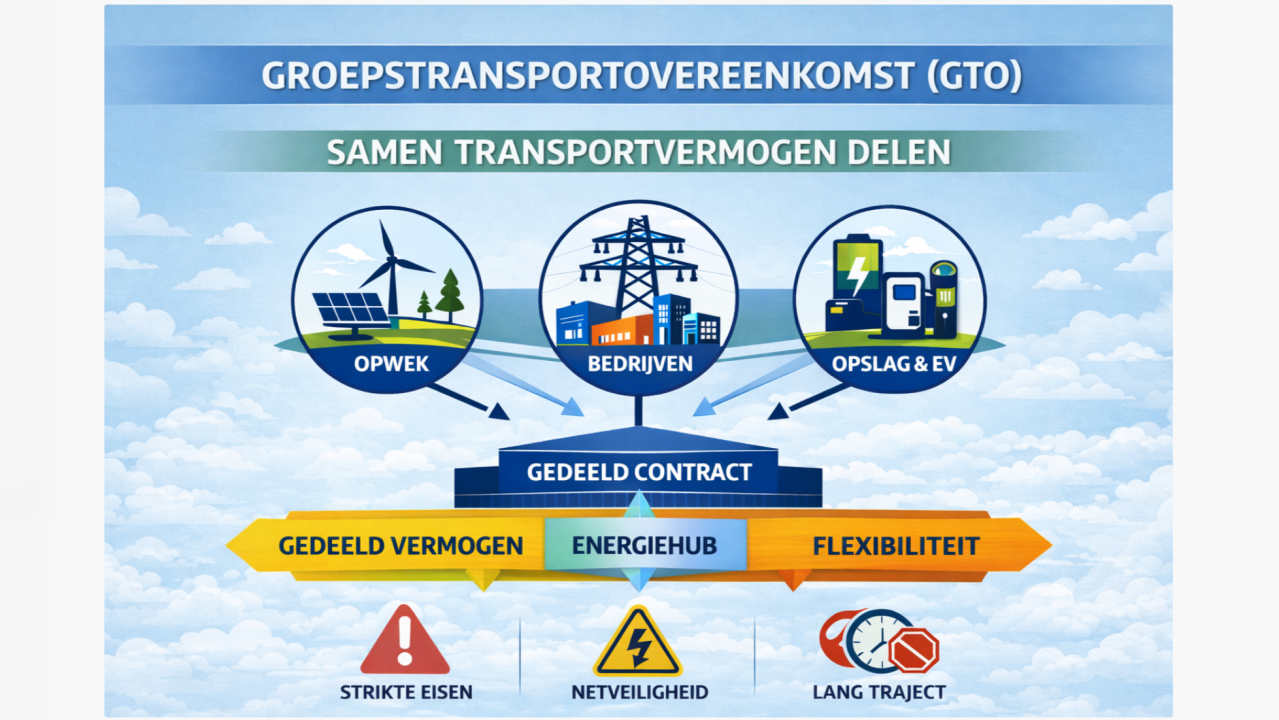
The Group Transport Agreement (GTO) is often presented as the breakthrough for grid congestion. Sharing, smarter use, creating space. That image is accurate— but only partially .
The GTO isn’t a generic solution. It’s a heavy-duty instrument that has profound implications for technology, governance, accountability, and planning. Underestimating this will lead to failure.
At Green Grid Solutions, we’re currently working on several energy hubs where the GTO plays a role. That’s precisely why we see both the potential and the friction.
What makes the GTO fundamentally different
The GTO isn’t about paper, but about grid physics . Multiple large consumers (connection >60kVA) surrender their individual transmission rights and receive collective group power in return. Within that group, you can move power among yourselves, as long as the net group profile remains within the agreed-upon limits.
That sounds logical, but in practice it means:
- You trade individual security for collective responsibility
- You make yourself dependent on the behavior of others
- You shift risks from grid operator to group
The GTO is therefore not an extension of rights, but a redistribution of responsibility .
The first hard limitation: not everyone is allowed to participate
The GTO is not freely applicable . It has the following important limitations:
- Only large consumer connections
- Specific connection categories (A3–A7)
- Physical proximity on the same network part
- No guarantee that combinations will be allowed
- Grid operator retains room for assessment
In other words: “Just wanting to work together” isn’t enough—the network also has to be able to handle it (technically). And that test isn’t transparent or uniform by region.
Interesting: experimental space (pilots) makes new combinations possible
What we find interesting in the ACM amendments is that there is explicit scope for testing whether broader group formation can work well.
In addition to the standard groups (e.g., A.3–A.5 among each other, A.6 among each other, A.7 among each other), it is now possible—if offered by the grid operator—for A.3–A.5 to form a group together with A.6 feed-ins . This still requires research and proper preconditions, but this is precisely where the potential lies for energy hubs: designing consumption and feed-in into a single system, with proper control logic.

A GTO stands or falls with data.
Grid operators determine group power based on:
- Historical quarter data
- Simultaneity of intake and intake
- Expected growth and concrete future plans
When determining the group GTV, the historical annual profiles of the past 24 months will now be taken into account , instead of 12 months (draft text GTO ACM).
A new feature is that concrete future plans that will be realized within three years must be included when determining the group’s contracted transport capacity (CTV). This is a significant step. The CTV allows the CTV to look not only backward, but also forward. This aligns better with the practice of redevelopment, electrification, and phased growth.
Problem: Many companies don’t have their data in order. Or their future plans are ambitious but not concrete. What’s the result?
- Conservatively allocated group capital
- Less space than expected
- Disappointment after contracting
The GTO punishes wishful thinking.
Governance: the most underestimated risk
The biggest snags are n’t technical , but organizational. Questions that must be answered beforehand:
- Who is authorized and for what exactly?
- Who is responsible for excess?
- What happens when you leave?
- How do you distribute costs and benefits?
- What if one party grows and the rest don’t?
Without firm mutual agreements, the GTO will not be a solution, but a conflict model. An energy hub is not a group of friends . It’s an economic system. Consider ensuring implementation, operation, and liability.
Planning: Why GTOs Are Rarely “Fast”
In theory, the GTO is available. In practice, there is a structural delay , and the causes are:
- Grid operators are in implementation phase
- Testing protocols are still in development
- Capacity calculations take time
- Iterations with data and scenarios are normal
Therefore, the following applies:
Anyone who uses the GTO as a last resort is usually too late.
The GTO belongs early in area development , not as a stopgap measure afterwards.
Financial incentives: smart, but not without obligation
The fee structure encourages collaborative behavior. But that only works if the group is manageable . So, without:
- joint monitoring
- active management (e.g. storage or flexibility)
- operational agreements
The advantage remains theoretical. The GTO rewards cooperation but punishes inaction .
Finally
The real question isn’t, “Can we get a GTO?” But, “Is this the right system design for this location, these parties, and this timing?”
Are you working on an energy hub, redevelopment, or a stalled connection? And want to avoid having to wait until the contract is signed to find out the intricacies? We’d love to talk!